Soft Washing vs Pressure Washing for Commercial Buildings
Commercial Exterior Cleaning · Jun 1, 2026 · By Nicholas Dunn
For commercial property in East Tennessee, the question is rarely whether a building needs cleaning. Humidity, pollen, and roof algae do their work on every facade in Knoxville. The real question is how the cleaning gets done, because the wrong method on the wrong surface can cost more to repair than years of routine maintenance. Soft washing and pressure washing are not interchangeable. They are two distinct approaches, and matching the method to the material is the single most important decision in any exterior cleaning plan.
This guide explains the difference in plain language, walks through which commercial surfaces call for which method, and outlines why getting it wrong creates real liability on a property you are responsible for.
Pressure Washing and Soft Washing, Defined
Pressure washing uses a high-pressure stream of water to physically remove dirt, grime, and buildup from hard, durable surfaces. The cleaning action is mechanical: the force of the water does the work. On the right material, that force is exactly what you want.
Soft washing uses low pressure, roughly the equivalent of a garden hose, combined with cleaning solutions and a biocide that kill algae, mold, mildew, and bacteria at the root. The cleaning action is chemical, not mechanical. Instead of blasting organic growth off a surface, soft washing neutralizes it so it can be rinsed away and is slower to return. Both methods have their place. Our pressure and soft washing services are built around choosing the correct one for each material on a property.
The PSI and Approach Difference
The most visible difference is pressure. Pressure washing can run well over a thousand PSI and is designed to dislodge stubborn buildup from surfaces that can take the force. Soft washing typically operates under about 100 PSI, low enough not to harm delicate or coated materials.
The less visible, but more important, difference is the cleaning solution. A high-pressure rinse can make a surface look clean for a few weeks, but if the underlying algae and spores are still alive, the growth simply returns. Soft washing treats the organism itself. That is why, for biological staining, low pressure with the right solution often outperforms raw force, and lasts considerably longer between cleanings.
A Surface-by-Surface Guide for Commercial Materials
The simplest way to think about it: hard, durable, ground-level surfaces can usually take pressure. Coated, applied, fragile, or elevated surfaces should be soft washed only. Below is how that breaks down across common commercial materials.
Surfaces where pressure washing is appropriate:
Concrete sidewalks and flatwork, where ground-in dirt, gum, and traffic film respond well to high pressure.
Parking lots and concrete drive lanes, which are built to withstand vehicle loads and tolerate mechanical cleaning.
Masonry pavers and durable hardscape, where pressure lifts embedded grime from joints and surfaces.
Surfaces that should be soft washed only:
EIFS and Dryvit synthetic stucco, which is essentially a foam-and-coating system that high pressure can puncture or saturate.
Traditional stucco, where force chips and erodes the finish.
Painted or coated metal panels, where pressure strips coatings and forces water behind seams.
Vinyl and composite siding, which can crack, warp, or take on water under high pressure.
Wood siding, trim, and fencing, which gouges and splinters easily.
Mortar joints in brick and block, where pressure blows out aging mortar and opens the wall to moisture.
Roofing of every type, including asphalt shingle, metal, and tile, which is covered in more detail below.
Roofs Are Never a Pressure-Washing Job
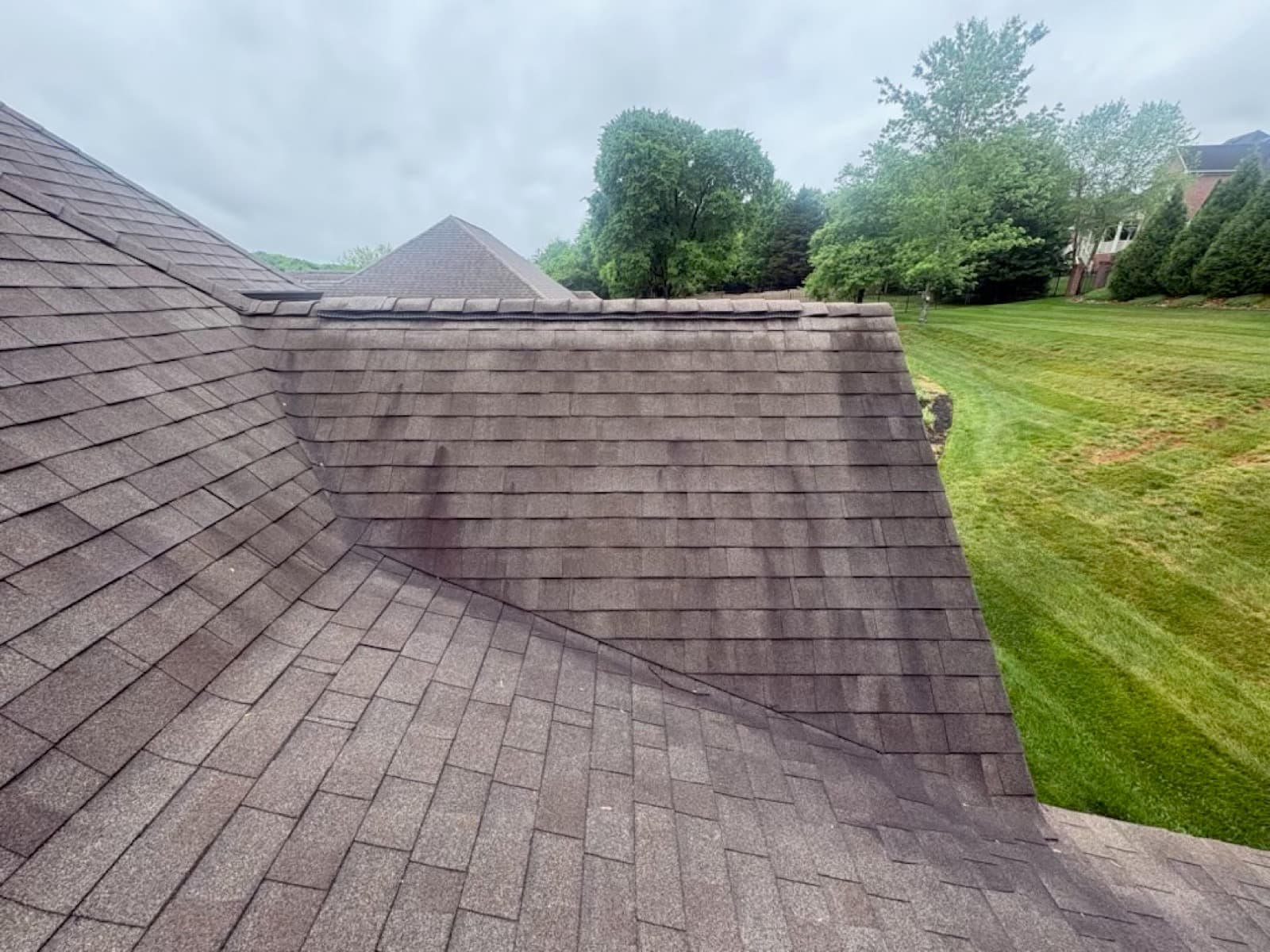
Roofing deserves its own warning. The black streaks staining roofs across Knoxville are caused by Gloeocapsa magma, a hardy algae that thrives in our warm, humid climate and feeds on the limestone filler in asphalt shingles. It is a living organism, and high pressure does not solve it. Blasting a shingle roof strips away the protective granules, shortens the roof's life, and can void the manufacturer's warranty, while the algae returns within months because the spores were never killed.
The correct approach is a low-pressure soft wash with an algaecide solution, the method recognized across the roofing industry for shingle cleaning. Our roof cleaning service treats the algae at the root so the roof stays clean far longer and the surface is never damaged in the process.
Why the Wrong Method Creates Liability on Commercial Property
On a home, using the wrong method might mean a damaged fence board or a streaky wall. On a commercial property, the stakes are higher, because the consequences are structural, financial, and legal.
High pressure on the wrong surface causes etching and gouging in stucco and wood, strips coatings off metal and painted finishes, blows out mortar joints, and drives water behind siding and into wall assemblies, where it leads to hidden moisture damage and mold. It can also void manufacturer warranties on roofing, coatings, and cladding systems. Repairing an EIFS facade or re-coating metal panels across a large building is a substantial expense, and a voided roof warranty can turn a routine repair into a full replacement.
For a property owner, manager, or tenant, that is direct liability. A vendor who damages a facade, or a public-facing surface where people walk and park, has created a problem you are now responsible for. Choosing a contractor who understands material-specific methods is not a detail; it is risk management.
Why Commercial Scale Changes the Plan
Beyond material selection, commercial buildings differ from homes in ways that reshape the entire job. Height and access often require lifts, extended reach equipment, or rope access rather than a ladder. Larger square footage means more surface area, more solution, and tighter scheduling. And because storefronts, lobbies, and parking areas are public-facing, the work has to account for customers, pedestrians, signage, and business hours.
A homeowner can clean a wall on a Saturday afternoon. A retail center, office building, or HOA needs a plan that protects landscaping, controls runoff responsibly, sequences work around tenants and visitors, and keeps the property presentable throughout. That is also why so many commercial clients move from one-off cleanings to a recurring schedule. Treating algae and grime on a predictable cycle, before it becomes staining or damage, is almost always cheaper than reacting to it. The case for preventative maintenance and the cost savings it delivers is straightforward: routine soft washing protects coatings and roofing while keeping a property looking maintained year-round. The same logic applies to keeping glass clear through scheduled window washing plans.
Quick Answers
Is soft washing or pressure washing better for a commercial building? It depends entirely on the surface. Hard, durable surfaces like concrete sidewalks and parking lots can be pressure washed. Coated, applied, or fragile surfaces, including EIFS, stucco, vinyl, painted metal, wood, and all roofing, should be soft washed only to avoid damage.
Why can't you just pressure wash a roof to remove the black streaks? Those streaks are Gloeocapsa magma algae, a living organism. High pressure strips protective granules, can void the roof warranty, and does not kill the algae, so it grows back. A low-pressure soft wash with an algaecide treats it at the root.
What's the risk of using the wrong cleaning method on commercial property? Etching, gouging, stripped coatings, blown-out mortar, water driven into wall assemblies, and voided warranties. On commercial property, that damage becomes a direct liability for the owner, manager, or tenant responsible for the building.
If you manage or own commercial property in Knoxville and want a cleaning plan that matches the method to every surface on the building, we can help. Reach out through our contact page to talk through your property, or learn how our maintenance plans keep facades, roofs, and grounds maintained on a predictable schedule. Homeowners are welcome too.
Need this handled on a schedule?
Knox Exterior Care Company keeps commercial properties clean on a maintenance plan across Knox, Anderson, and Blount counties.